Dear M24s

May 18, 2013

Open letter to the M24s,

No more months or weeks, you’re now counting down the days before staging to prepare for arrival in Mongolia. Like you, I had many questions and turned to the web for answers. I found my greatest resource to be a PCV blog, and I read it word for word from the beginning. But since everyone’s experience is different, I committed to keeping my own blog, as much for me as for you. Thirty-seven posts later, I hope you’ve found something useful in here.

Probably also like you, my biggest concern was the weather. Well, let me allay that fear first. On a Saturday in January—what should have been the dead of winter—I sat in my apartment with the window open, wearing a pair of jeans and a sweater. The temperature was -11C/13F. I don’t want to give the impression that it hasn’t been cold, just that it’s possible to adapt to the point where 13F feels pleasant. I can’t believe it myself.

As you’re scrambling to get those last-minute, must-have-in-Mongolia items, and I’ve seen lots of discussions on the group page, I’ll remind you that everyone’s list will be different, depending on who you are, and who you want to become, as this surely is an opportunity to reinvent yourself.

With that, these are my top three items from home:

My pillow: If you have no attachments to your current pillow maybe you can dismiss this, but I really liked my pillow from home. (Mongolian pillows might not even be pillows… I actually heard of a teddy bear inside a pillow case.) Yes, it’s bulky, but it doesn’t weigh much at all. I strapped it to the back of my backpack so it didn’t take up any room. It was nice to have on the planes and during that first week of moving from place to place. And at my host family’s, having a plush pillow compensated for the firm bed that was only as cushy as my sleeping bag folded in half.

My sunhat: Keeping the sun off my face and out of my eyes was a priority even before I felt how strong the summer sun is here. It never occurred to me to disregard the no-contact-lenses directive so the sunhat was needed in lieu of sunglasses. We had quite a bit of rain last summer, and my water-resistant sunhat doubled as a rain hat.

My Kindle: One of my personal goals as I would be starting over was to kick the TV habit (i.e., turning on the TV and then finding something to watch). Thanks to my e-reader, in the past year I’ve read over 40 books—probably an 800% increase. While I haven’t loved all of the books, I’ve loved all of the time I’ve spent reading them. Just one way in which I am becoming the person I’ve wanted to be.

Other items have been quite useful: the watch with 3 alarms (since we didn’t have phones during PST), the Swiss Army Knife (specifically for the can opener which takes some getting used to but has to be safer than my host mom using a kitchen knife—I couldn’t watch!), the camelbak backpack , the hiking boots, the hard-drive (500GB, probably not enough), the iPod (especially nice on the long bumpy rides), and the Skype account so that I could call my family and friends who aren’t online.

Of the Peace Corps staff, I’ll say this: I’ve always felt that they have my safety at the forefront of their decisions. I find them to be highly competent, compassionate, and professional individuals who are dedicated to the mission of Peace Corps/Mongolia. You’ll be in good hands.

Of the PCT/PCV peers, I’ll say this: Being completely candid, at first glance, I wondered about some of them “why did they want to be here?” and “how did they get chosen to be invited?” And, yet, those few about whom I had reservations, after just a few one-on-one conversations, every single one beautifully expressed their genuine desire to be here in Mongolia and to serve in the Peace Corps. As soon as you’re tempted to dismiss someone, go over and introduce yourself instead.

Of the Peace Corps experience, I’ll say this: We are part of a government agency that has bureaucracy, reporting policies, a chain of command, and expectations of accountability. As a way to manage your own expectations, it is important to remember that The Peace Corps is made up of individuals: we are not perfect, we make mistakes, and we have bad days. This is a unique experience that requires a bit more understanding, a bit more patience, a bit more forgiveness than you might be prepared for.

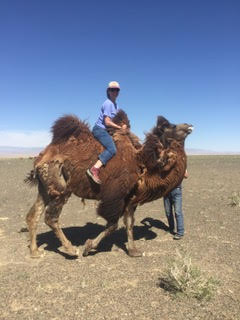
But you are coming to a wonderful country, rich with culture, and full of friendly faces. There will be more good days than bad. The time will go quicker than you imagined. You will learn from those around you. You will learn about yourself. You will see breathtaking sunsets. You may even ride a camel. But above all else, you will reach people, personally; you will make an impact; you will be remembered.

Welcome to Mongolia. I look forward to meeting you.

~Love


a flexourtient person

May 10, 2013

After 27 months of service, Peace Corps Volunteers—whoever they may have been prior to service—may come to define themselves as flexible, resourceful, and patient. This blog entry is about how that metamorphosis happens.

Monday, April 8th this year was the English Olympics. That is a test that some 9th and 11th graders, and all English teachers, must take (take, not pass). The test consists of grammar, reading comprehension, vocabulary, listening comprehension, and essay writing. Being a native English speaker, the tests certainly illustrated what I take for granted. But, this blog entry is not about that…

Since all of the soum teachers (35-ish) would be coming to the Aimag capital to take the test, a few weeks prior my CP asked me to give about an hour’s presentation, as part of their full-day seminar on Wednesday. She wanted me to cover “Teaching English Grammar without Translation,” one of the activities we had during IST. The day before the seminar, my CP informs me that I will have 3 hours, and suggests that I do some other lesson since the school year is almost over, saving that one for the fall seminar. “You want me to give a 3-hour presentation? Tomorrow?” I asked, somewhat incredulously, somewhat rhetorically. “Yes,” she answered, with the straightest of faces.

I pulled together a morning that looked something like this: warm-up exercise (Head, Shoulders, Knees and Toes); a presentation that I’d already created and never gave on Multiple-Choice Tests; a presentation on Public Speaking that I’d created and gave to about 8 teachers but figured repetition for them couldn’t hurt; a collection of ways to build vocabulary, which included, as a listening activity, a podcast from the Matty in the Morning show wherein a Canadian man plans a surprise wedding for his girlfriend (they weren’t even engaged!); and a chance to tackle as a group the essay question from the Olympics test (“Should travelers adopt local customs when they visit a foreign country, or should the country welcome visitors’ diversity?”).

Given the way it was thrown together, I was pretty happy with the session. But, in reality, I think I spoke too quickly for a non-native audience, used too many obscure words (such as “obscure”), generally did too much talking rather than getting them to speak, and didn’t have a way to measure the usefulness or practicality of the information I was giving them.

A week after the English teachers’ seminar, on Thursday around 4pm, my CP called to tell me I was going on the Education Department’s trip to visit 5 soums. I’d be leaving the next morning, at 7:30am. I’d be gone for 10 days.

While it is true that visiting soums was in my “work plan” when I began last fall, it was put off for so long because of lack of funds. So it wasn’t that the trip was happening that threw me, it was the timing of when I was told about it to when I was expected to be ready to leave. No part of me thinks that this trip was thrown together at the last minute or that anyone else in the department was frantically running through a checklist of what to do. But I didn’t have time to fret about the last-minute notice: I had a bag to pack, a plant to water, and electronics to charge. I also had to notify Peace Corps that I was leaving site. I grabbed a few story-books from the resource room and headed home.

The week that followed can only be described as a whirlwind. Peace Corps had asked me to provide them with a schedule (soum name and dates we would be there), the type of transportation and the number of men and women. Armed with this information, I still had no clue about such practical concerns as sleeping arrangements, meal plans, or what exactly I was expected to do. The good thing was that, though I’d started out winging-it, with each new soum I had a little more experience from which to draw.

These are some highlights from this trip:
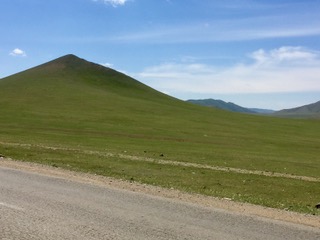
- Four of the soums were similar in size (2,000 people), one a bit larger (3,000). Some soums, including at least one of these 5, have an 11pm lights-out policy, enforced by shutting off the electricity. The landscapes varied; the most shocking was Hukhmort, the soum built on sand. Several soums had no internet access. One had a legit karaoke club. From two of the soums we drove about 30 minutes to see sand dunes with a lake or a gorgeous marshland surrounded by mountains… made me wonder how these soums came to be where they were, rather than at the “Beautiful Place.”
- Our entire group stayed in the school’s dormitory. Regular public schools have dormitories to house the students whose families live in the countryside. As I understand it, this is free to them. The dormitories vary quite a bit from soum to soum: spacious rooms or small rooms, with bunks or singles. One dormitory, notable for its indoor plumbing, had been awarded Best Dormitory of 2012, with a cash prize of 500,000 togrogs (~$350).
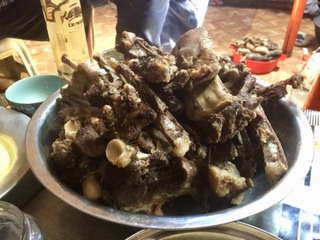
- Our meals (mainly carbs, meat and pickles) were all provided, either room service by the school’s cafeteria or at a horkhok—a sort of picnic wherein the meat is cooked outside.
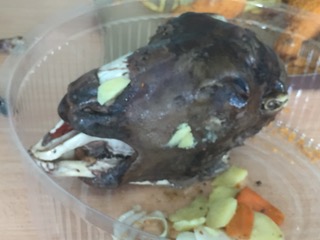
- I ate marmot, and liked it! It is a red meat, but soft like chicken. They don’t use much in the way of seasoning here, so it could only be even better. I didn’t know what a marmot looked like until I told my sister-in-law and she emailed me a picture (Tricia, you meanie); they’re so cute!
- In Darvi soum, we had a tour of the brand new kindergarten. I recall that, from the outside, it didn’t look very kindergarten-like, but the construction was first rate. The proud teachers demonstrated the kid-sized flush toilets and working sinks in each of the bathrooms; they had us wear booties to cover our shoes before allowing us on the classroom carpets.
- Students were enthralled by my ability to “bridge-shuffle” my deck of UNO cards. I think it was my cousin Allyson who taught me when I was around 10 or 11 and we played hours of Spite and Malice. So, a big thanks to you, cuz!
- I sang “my” Mongolian song at least 8 times. At each soum’s group event, my department colleagues insisted I sing it; at the last soum, one of the teachers insisted I sing it for each of her three classes. Би шинэ дуу хэрэгтэй (Be sheen doe herekhtay; I need a new song).
- Riding for hours at a time on unpaved roads is a skill that Mongolians have mastered. Reading and hat-making were out of the question for me, but, I kid you not, one of my colleagues threaded a needle and re-secured her purse strap, while I looked on tightening my grip on the seat in front of me. While they were slumped over napping, I was being tossed about, every which way, wishing I had a seatbelt, not for safety, but just to keep me tethered to the seat so that I didn’t crash back down after every bump or dip.
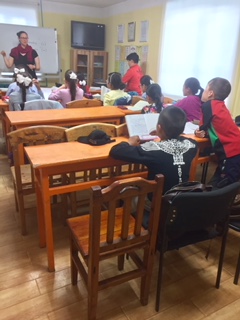
- I spent my “work” time observing teachers in the classroom and giving feedback, touring the schools, their facilities and the soum beyond the school, attending meetings (I stopped after 2 since I got little out of them and had nothing to add), and attending organized seemingly mandatory socializing events. I spent my “student” time answering questions (formally or not), reading short stories, teaching them UNO, teaching them an English song, or just visiting. I spent my “down” time, of which there was very little, reading, making a hat, or trying to keep up with my language studies.

On a personal note, I had already considered myself a flexible, resourceful, and patient person. But these experiences are testing those traits, even redefining them.

Pics of the soum visits can be found here.


spring

May 4, 2013

Prologue

I tried to write this blog entry about leaving winter behind and welcoming spring, but this is nothing like the spring I know. For so many years, spring to me has meant the first blossoms on the magnolia trees at St. Leonard’s Church and Peace Garden in Boston’s North End. It meant throwing the windows open, welcoming in that change in the air. It meant being able to walk home from work: Comm Ave through the Boston Commons, if I wanted some quiet time, or Newbury St and Faneuil Hall if I wanted to people-watch. A few years ago it meant watching my high school classmate run in the big race: in my boisterous excitement, my camera lens only caught the pavement as I tried to snap his photo while holding my homemade sign. Last year it meant finally(!) getting to ride Hubway again.

Since arriving in my permanent site 8 months ago, I’ve nurtured this tie to my hometown with Matty in the Morning podcasts and Robert B. Parker Spencer novels. I haven’t romanticized living in Boston, though. I remember the day I understood what my big sis was talking about when she visited us in San Diego and said how nice it was that people walking down the street said “hello” and looked you in the eye, after I’d moved back to Boston and that didn’t happen. They all let their guard down when the Sox won the Series in ’04—strangers high-fiving and giving hugs—but it didn’t last. I well remember the day I tripped going up the escalator at Ruggles Station, completely ignored by my fellow rush-hour commuters. The people irked me, but I never held this against the city.

This time next year, I’ll be doing what my M22 site-mates are doing now: making preparations for Close of Service. I honestly don’t know where I will end up. Coming into the Peace Corps meant a chance to start over, twice, and this wasn’t lost on me during the application stage. Before I was even officially invited to serve, I looked forward to my post-Peace Corps life, with two years’ experience living and working abroad, and what kind of growth that could mean for me, personally, and where, literally, that could take me. There’s a chance I won’t go back to Boston for good, but Boston will always be my home.

And now, back to the blog: The Winter that wasn’t

I promised an update when “real” winter came… but it never did, not to my aimag, anyway. Now this may seem strange to those of you who recall my frozen toes that didn’t defrost for 3 months, but I’ll remind you that that incident occurred in UB. So, winter—as I feared it to be—definitely came to UB. And I’ve seen photographic evidence among my PCV friends, whose frozen eyelashes and beards left no doubt, that winter definitely came to other parts of Mongolia. But here in the Southwestern aimag of Govi-Altai, we’re well into spring now and aside from a few days here and there during January and February, I never felt that the regular negative temps (in both C and F) were unbearable.

Spring here sort of seems to me like winter-in-reverse: during November and December, I kept waiting for the deluge of snow, but there was never more than an inch or two at a time, and it often melted by the end of the day. (A curious observation is that our snow, when it comes, generally comes overnight.) During March and April, what winter we did have kept asserting itself in fits and starts, but by then its attempts weren’t worrisome. I haven’t worn my Mongolian winter boots since sometime in March, and though I haven’t packed away my winter coat, it wasn’t needed for most of April. This has all fluctuated, of course; there was a day at the end of March that was pleasant enough for just my Boston hoodie, and there were a few snow days in April.

I was mentally preparing for the heat in my apartment to be turned off in March. It would have been unpleasant, for sure, but nothing like waking up in a ger in winter when your overnight fire has long since burned out; I wouldn’t have felt justified in complaining. The heat burned on into April, though, and I was back to opening my window to let in some fresh air, whenever the wind was calm enough to not bring the dust inside. Over the last few weeks, I’ve adopted a new trick: leaving the apartment door open. Since that outer room has no heat, the cooler air wafts in, but there’s no wind and therefore no dust. Now it’s early May, and the heat is STILL on, with outside temps in the 50s/60s F.

The mountains here are back to brown with just patches of snow taunting the sun, but I’ve seen patches of green grass crop up in unexpected places that makes me smile. So, naturally, that’s what I’m looking toward.


pet peeves

April 14, 2013

Alright, so I do a lot of gushing on this blog about how I’ve adapted so well, how the people are so encouraging and supportive, how charming the culture is, etc., that you may be wondering if I ever have a bad day. How can you trust what I have to say if it isn’t balanced reporting? Surely there must be things that bug me, right? Well, I generally do describe myself as “more happy than not happy” but, yes, even I can get disgruntled. So, what does it? What causes me to regard something as annoying in Mongolia? Here goes:

The date

By usual American standards, we would write today’s date as April 14, 2013. We know, however, that other parts of the world would write 14 April 2013, and we can accept this. In one of our language classes during PST, our teacher wrote the date on the board and received the ultimate, most sincere objection ever from fellow trainee Steven, “Absolutely not, you can’t do that! Why would you ever do that?” So, what could she have done to bring about such resistance from this otherwise gentle California dude? She mixed Roman numerals with regular old numbers. To write 14/IV 2013 is unfathomable.  

Watch Your Step

When I wrote about the streetlights going off exacerbating the danger of the coverless manholes and the uneven streets, you may have been led to believe that the walking hazards were limited to outside. But that is hardly the case. It may even be the norm that staircases are uneven in Mongolia. When climbing up, every time I go to put my weight down, only to end up slamming my foot on a step that is an inch or two lower than expected, I think “Why?” Sometimes, because the whole staircase was off, that last step up is only an inch high. And they aren’t just differing heights, but they slant in every possible direction. And we all know I have large feet by American standards, so in Mongolia they are especially large. But, still, I think the depth of the stairs is far too shallow. Either I walk on tip toes, or else I walk diagonally. Going down is particularly challenging.

I can’t read this!

So, ten months later, I still have trouble with differentiating between the “O sounds” as previously written, but what’s worse is that I can’t read anything in Mongolian that isn’t written in block Cyrillic. There are a few people in my life whose penmanship is so unique (first prize to Krin!) but, being written in English and me having a vested interest in understanding them and already knowing the context, such notes are decipherable. There are so many acceptable ways to write letters here that even words that I know look foreign (ha!) to me. I will post a picture of this, I promise. Then, of course, there is the whole issue of spelling Mongolian words with the Roman alphabet (a.k.a. English) but to accommodate sounds that don’t exist in English, there are multiple acceptable spellings for single common words. Sigh…

That’s not a word!

 “За” (Za) is probably comparable to “um” in terms of how often it is used. But, whereas “um” is a space filler, “za” apparently has actual information. I’m just not confident enough to try it out. Depending on the situation, it could mean, “yes, I hear you” (not that I necessarily agree with you), it could indicate a transition to another topic, or that the discussion has come to an end.

That’s a brand.

There are certain brand names that we (Americans) use in place of the generic. I was once so aware of this that I wrote them down, but all I can remember offhand is Xerox and Chapstick. And maybe White-Out, some version of which is still in use here. In Mongolia, it’s Scotch, as in packing tape. I don’t know the word for tape because I’ve only ever heard “do you have any Scotch?” The funny thing is I’ve never even seen the Scotch brand here! 

Are you having difficulty breathing?

What’s really weird to me is that I missed this for the first 2 months… I suppose it’s similar to our “mm-hmm” or “uh-uh,” instead of actually saying “yes” or “no.” What the Mongolians do, and I don’t see myself adopting this, is a breathy exhale or inhale. The word for “no” is “үгүй,” phonetically that is “oo-gwee” but it’s generally shortened to “oh-go”—in fact, my host family seemed to tease my need to say it as it is spelled (all in fun and no hard feelings). Now, the shortened “oh-go” is further shortened to just the “go” part, but it is said as if you were Darth Vader. And, I’m going to have to assume that from there, the breathy inhale for “yes” evolved (since it’s the opposite of an exhale) because I can’t otherwise explain it. But, everyone does this. It doesn’t have the same formal vs. casual connotations that our shortened versions seem to have. And once I became aware of it, I hear it all the time.


And now for a few things that aren’t pet peeves exactly, but they are noteworthy and I can’t think of another place to put them.

Lighting

I’ve noticed this since the beginning and somewhere I have a picture of what I mean, but I’ll try to explain it here. The wiring in this country, especially in the older buildings, is an afterthought. There are exposed wires that are tacked along the wall to get to the destination, or else an unsightly hole in the wall to let the wires out. Light switches and outlets are sometimes dangling from the wire, not attached to the wall. (It’s common enough that Peace Corps rules for host families specified that the Volunteer’s room had to have an outlet attached to the wall.) Despite this apparent apathy towards the aesthetics of electric pathways, there are often very flamboyant lighting fixtures. Certainly, there are just as many bare light bulbs, but when there is a light fixture of any kind it is sure to be eye-catching.

Hop in!

Motorcycles are very common here, as I’ve documented previously. What I haven’t said is that a significant portion of them (maybe 5-10%) have a side car attached. I recently saw an эмээ (Em-may, grandmother), wearing the traditional Mongolian deel, riding in a side-car. No pics yet, but surely it’s just a matter of time.


consolidation

April 8, 2013

Monday last week, our site’s warden called to tell me we got the call we’d been expecting: Consolidation. Part of Peace Corps’ Safety and Security efforts include having a consolidation drill, wherein all volunteers are to stop what they’re doing and report to to the warden’s home ASAP. It’s done once a year, and hadn’t happened in my first 7 months at site, so we had recently been wondering when it would happen.

During Consolidation, PCVs are expected to bring their sleeping bags, emergency contact information (as in, those local people we call in an emergency, not our individual information), snacks, water, and stuff to keep ourselves occupied since we don’t know how long we’ll be holed up together. In addition to contacting and hosting all the volunteers, the Warden logs how long it takes for each person to arrive and relays this information back to Peace Corps’ Safety and Security Officer. (I’m the Sub-Warden, so this will be my charge next year.)

I was the third and final PCV to arrive. I thought I’d made good time but was surprised that it took me 31 minutes (even though I live the farthest from the Warden). When I walked in the door, the Warden said, “now that you’re all here, April Fools!” They made up for it with chocolate chip pancackes, though.


the other blog

April 4, 2013

It’s been longer than I realized since you were last invited To Mongolia with Love, and yet, I’ve been writing lots… Through the Paul D. Coverdell World Wise Schools program, which matches Peace Corps Volunteers around the world with American classrooms,  I’ve been communicating with a school in Minnesota. It is a wonderful opportunity for American students to see the world through the eyes of another American, since we, presumably, have a similar foundation for cultural norms and expectations. That is, American Volunteers will be better able to identify the cultural similarities and differences, than if you were to ask someone from the host country.

Maybe you’ve had a curiosity, but hadn’t turned it into a question. Maybe you’ve been a loyal follower of this blog and something I’ve written has struck you, in a good or bad way. Maybe you just want to know everything, making any one question insufficient. Well, these kids have done the work for you. I’ve found their questions to allow me to revisit some of what I’ve written, to force me to think of things I hadn’t thought of, and to reflect on my experiences after time has passed.

The direct link to the current content is here . But as the other classes are added, you’ll want to go here and choose the group of questions from the dropdown menu (by hovering over 2013 Peace Corps Correspondent Match – Mongolia).

Enjoy!


hello

March 15, 2013

I’m so used to it now that it no longer seems strange, until I imagine it happening in the USA. Then I remember how remarkable it truly is. 

Let’s say you studied Spanish, as I did for 4 years. And let’s say you didn’t live in a large Spanish-speaking town (which wasn’t the case for me but is necessary for the comparison). The parallel situation is, essentially, that you’d shout “Hola!” at every person who looks like they might speak Spanish. Crazy, huh?! Well, that’s kind of what it’s like here. 

There was a young boy in my training site who, whenever he saw us, rode across the field on his bicycle shouting, “Hello, my name is Garnum!” Well, I’m not entirely sure that was his name because all efforts to engage in conversation with him led to his cycling away. But his opening with such enthusiasm was quite unexpected so early on in my service. Now, it is the norm. 

The standard around Govi-Altai is that students who are learning English will give a confident “Hi” or “Hello.” To them I will respond in kind. Sometimes there is a “What is your name?” or “How old are you?” in either direction. A few of the daring young ones, those not yet learning English, will make the attempt at a “Hello” or “Hi” and that’s the end of it. To the shy young ones, I give a smile and a Mongolian greeting, which sometimes turns into a dialogue exhausting all my questions and answers in a few minutes. 

Occasionally, I am taken aback by something quite unexpected. The best for my sense of purpose was when a girl said, “Hello, Love.” I figured I must have taught her class recently and she remembered my name. The best for my sense of humor was the boy who said, “Hi. Baby.” I was prepared to give a “hi” back, but the delayed “baby” totally threw me and I could only laugh. And every once in a while, there is a random person just waiting for the opportunity to try out the one English phrase they know, be it “Merry Christmas,” “I love you,” or “Happy Birthday.”

Some of the other volunteers have gotten “hellos” in Russian or German, but not me, not yet. If it happens, it will probably lead to a blog wherein I assert my American-ness. Until then, Goodbye!


Follow

Get every new post delivered to your Inbox.

Join 36 other followers